When we fall.
Not if.
There is something startling about that distinction.
We are accustomed to being told to keep going. We are considerably less accustomed to being told that we may keep going and still fall.
Most of our language about perseverance contains a promise hidden inside it. Keep trying, and eventually you will succeed. Don’t give up, and eventually you will get there. Have faith, and somehow things will work out.
We like these ideas because they make perseverance transactional. If I provide sufficient courage, sufficient effort, sufficient faith, sufficient goodness, then life will eventually provide the corresponding result.
But that is not what these words say.
There is no promise in them.
We must go on.
And:
We may fall.
Those two truths are not opposites.
Perhaps maturity begins when we become capable of holding them both.
The Hebrew Scriptures certainly do.
They contain victory and deliverance, but they also contain an extraordinary refusal to pretend that righteousness makes a person invulnerable.
Job is righteous, and catastrophe comes anyway. Jeremiah speaks truth and suffers for it. David wins battles and loses children. Moses devotes his life to leading a people toward a land he himself will never enter.
And Ecclesiastes says something that should permanently complicate any theology promising that virtue and effort produce favorable outcomes:
“The race is not to the swift, nor the battle to the strong…”
—Ecclesiastes 9:11
The sentence continues by telling us that bread does not necessarily come to the wise, wealth does not necessarily come to the discerning, and favor does not necessarily come to the knowledgeable.
In other words: Life is not a meritocracy. Neither, apparently, is history.
The strongest do not always win. The wisest are not always heard. The innocent are not always protected. The righteous are not always rescued.
There are battles worth fighting that we will lose. There are people we will love whom we cannot save. There are things we will build that will be destroyed. There are wrongs that will not be made right within the lifetime of the person who suffered them.
This is not pessimism. It is reality.
And any spiritual worldview that requires us to deny reality in order to preserve our faith has confused faith with fantasy.
Perhaps this is why the book of Job is so uncomfortable.
Job’s friends desperately want the universe to make moral sense. Something terrible has happened to Job, therefore Job must have done something to deserve it. There must be an explanation. There must be some hidden moral equation that restores order to the world.
They would rather accuse an innocent man than surrender their belief that the world reliably rewards goodness and punishes wickedness.
Job refuses. He will not confess to sins he did not commit simply to make their theology work.
There is something profoundly important in that refusal. Because sometimes the most faithful thing we can do is stop trying to make reality more comforting than it is.
Sometimes there is no explanation available to us. Sometimes what happened was simply terrible. Sometimes the person who deserved better did not receive better. Sometimes evil succeeded. Sometimes the good person died. Sometimes we fall.
And yet the words with which we began do not conclude there.
They begin somewhere else entirely: We must go on.
Why? That is the question I find myself asking.
If goodness does not guarantee protection, why be good? If justice may not arrive in our lifetime, why pursue it? If the thing we build may someday be destroyed, why build it? If we are going to fall anyway, what exactly is the point of standing back up?
Perhaps we have misunderstood the reason.
Perhaps we do not continue because continuation guarantees a particular outcome. Perhaps we continue because there are choices whose value does not depend upon whether they succeed.
Telling the truth may cost us more than lying. Doing what is right may leave us with less than doing what is expedient. Standing between another human being and harm may accomplish nothing except placing us in harm’s way beside them. And still, there are things we must refuse to become simply because becoming them would make survival easier.
Outcome matters.
But so does who we are when the outcome arrives.
There are things more important than winning.
Which brings us back to that final word:
Dignity.
I have not yet told you where the words at the beginning of this sermon came from.
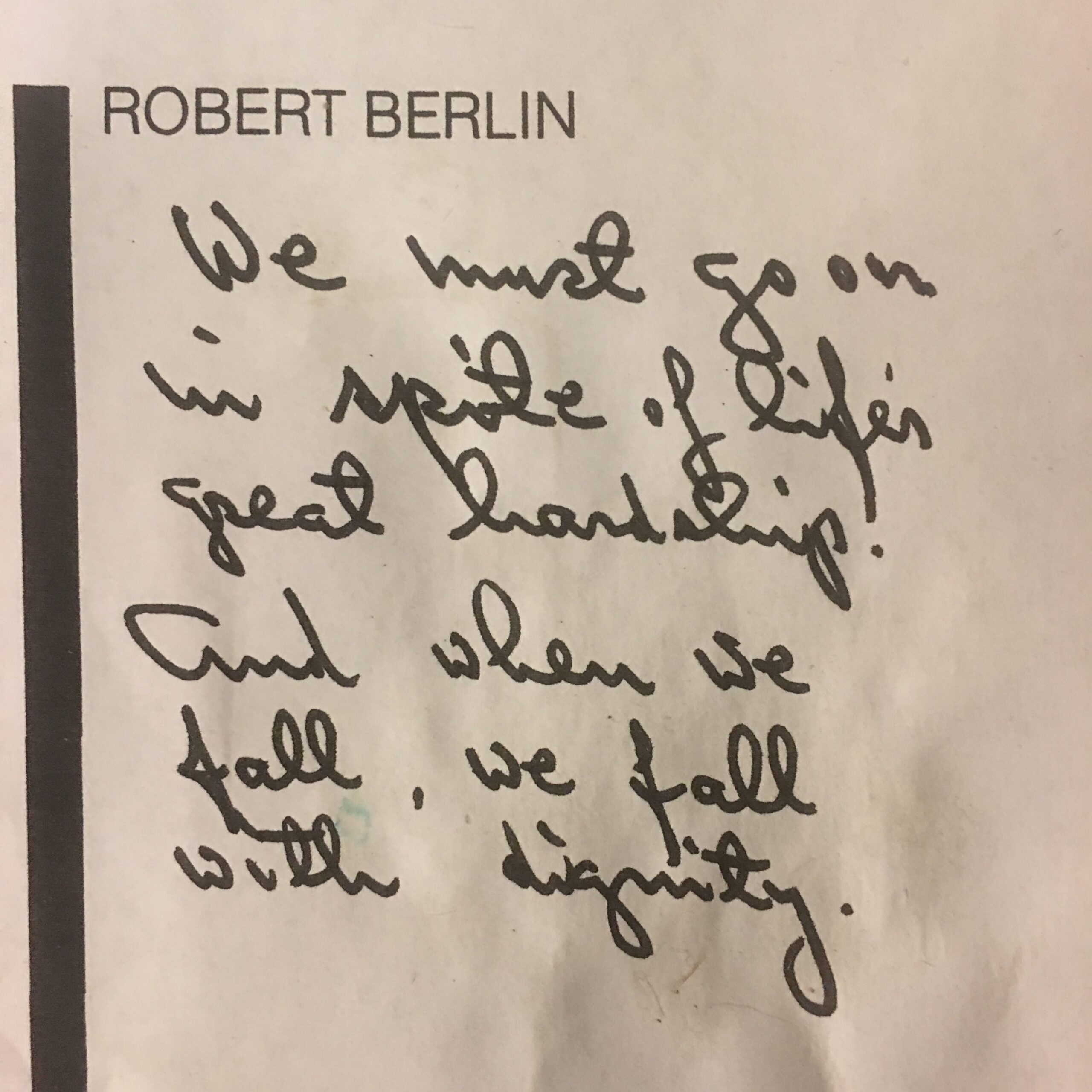
After my grandfather died, I found them among his things. They were written in his own hand.
My grandfather was a Holocaust survivor.
And once you know that, the words cannot be heard casually anymore.
“We must go on in spite of life’s great hardship.”
He was not theorizing about hardship.
And when he wrote:
“When we fall…”
he belonged to a generation of Jews who knew with unbearable clarity that sometimes good people do everything they can to remain standing and the world brings them down anyway.
Six million Jews did not fail to persevere. They did not fail to have enough faith. They did not fail to think positively. They did not fail some test of character that the survivors passed.
Children were murdered. The elderly were murdered. The faithful were murdered. The skeptical were murdered. The courageous were murdered. People resisted and were murdered. People complied in the hope of protecting their children and were murdered. People prayed and were murdered. People who desperately wanted to live were murdered.
There is no spiritually responsible way to turn that into a story in which perseverance guarantees survival. And there is no explanation we can offer that makes those deaths acceptable.
Some things should remain unacceptable. Some things should offend us forever. Some things should not be transformed into tidy lessons about how everything happens for a reason.
So when a man who survived that world writes, “We must go on,” I hear something very different from optimism.
I hear defiance.
Not the defiance that says, You cannot hurt me. Human beings can hurt one another terribly. Not the defiance that says, You cannot defeat me.
Sometimes we are defeated. It is the deeper defiance that says: What happens to me does not determine what I am worth.
And perhaps that is where dignity enters.
The Hebrew Scriptures make an astonishing claim about human beings almost immediately. Genesis says that humanity is created b’tzelem Elohim—in the image of G-d.
We repeat that phrase so often that it is easy to miss how radical it is.
If human dignity originates there, then human dignity does not originate in the state. It does not originate in wealth. It does not originate in achievement. It does not originate in strength, beauty, intelligence, independence, usefulness, citizenship, reputation, or the approval of other people.
And what human beings did not give us, human beings do not possess the authority to take away. A government can revoke your citizenship.
It cannot revoke tzelem Elohim. Someone can steal your property.
They cannot steal tzelem Elohim. Illness can take your strength. Another person can humiliate you. A system can imprison you. None of them has jurisdiction over the image of G-d within you.
This matters enormously when we speak about the Holocaust because dehumanization was not merely incidental to the machinery of extermination. It was part of the machinery.
People were stripped of their professions. Their property. Their citizenship. Their homes. Their clothing. Their families. Their names.
Human beings were reduced to numbers.
The objective was not merely to kill human beings. It was first to construct a world in which those human beings could be treated as though their humanity had ceased to exist.
But there is a distinction between treating someone as less than human and actually making them less than human.
The first is horrifyingly possible. The second is not.
No regime possesses that authority. No ideology possesses that authority. No camp possessed that authority. No uniform possessed that authority.
Nothing done to a human being can make that human being cease to bear tzelem Elohim.
Perhaps this is what it means to fall with dignity.
Not to fall gracefully. Not to remain stoic. Not to suppress terror or grief. Not to pretend suffering does not hurt. And certainly not to suggest that those who broke beneath unbearable circumstances somehow lacked dignity.
Dignity is not a performance we owe the people watching us suffer.
Dignity is something more fundamental. It is the recognition that what happens to a human being does not determine the value of that human being.
My grandfather survived. That fact is an obvious part of my family’s history. But holding this little note made me understand survival differently. Because, of course, I am one of the consequences of the fact that he went on. I am here because he remained here long enough for there to be an after.
And I want to be careful about what that means.
My existence does not redeem the Holocaust, not even in the slightest measure. No child or grandchild can retroactively make atrocity worthwhile. There is no possible future beautiful enough to justify what happened.
But there is a difference between claiming that evil happened for a reason and recognizing that evil did not obtain everything it intended.
The Nazis did not merely intend to murder individual Jews. They intended a world without Jews. They intended to erase a people not only from the present, but from the future.
And yet decades later, I found a scrap of paper bearing my grandfather’s handwriting.
His granddaughter picked it up. His granddaughter read it. His granddaughter carried it forward. And now I am speaking his words to you.
That does not undo what happened. But neither is it nothing.
There is something almost breathtaking about how far those few handwritten words have traveled. From his hand. Through a life that was once marked for extinction. Into mine. And now into yours.
We must go on.
Perhaps that is how human beings have always carried what matters through history. Not because any generation is guaranteed to finish the work. But because someone carries it as far as they can and then places it into another pair of hands.
Moses does not enter the Promised Land. But Israel does. The person who begins the journey is not always the person who sees its completion.
Perhaps that is not failure. Perhaps our responsibility was never to complete everything. Perhaps our responsibility is to carry what is ours to carry for as long as we are able.
Truth. Justice. Memory. Mercy. Responsibility. The people entrusted to us. The work placed before us. The image of G-d within ourselves and within one another.
And someday, despite every effort, we will fall. Every one of us.
If the command were win, then ultimately every human life would end in failure.
But that was never the command. It couldn’t have been.
Perhaps the command is simpler.
And harder.
While you can go on— go on.
When you fall— do not confuse falling with becoming worthless.
When the world treats another human being as less than human—
refuse the lie. When suffering strips away the things by which you once knew yourself— remember what remains. When goodness is not rewarded— choose what is good anyway. When justice is not assured— pursue it anyway. When you cannot finish the work— carry it as far as you can. And when the day comes that you can carry it no farther, place it into someone else’s hands.
My grandfather did.
“We must go on
in spite of life’s
great hardship.
And when we
fall, we fall
with dignity.”



One Comment