
There is a tendency among human beings to underestimate the significance of ordinary moments.
We imagine history is shaped by grand speeches, dramatic events, famous leaders, revolutions, elections, interventions, and wars. We assume that if our lives are ever going to matter, it will be because of some extraordinary thing we someday accomplish.
But the Hebrew Scriptures tell a remarkably different story.
Again and again, they invite us to pay attention not first to the spectacular, but to the seemingly insignificant.
A conversation.
A choice.
A habit.
A word spoken in anger.
A moment of honesty.
A small act of generosity.
A decision to forgive.
Or a decision not to.
These moments appear small because we tend to measure life arithmetically. We think in terms of addition. One good deed plus another good deed plus another. One mistake plus another mistake.
But what if morality does not operate primarily through addition?
What if it operates through multiplication?
I have been thinking about a concept I call spiritual exponentialism.
The idea is simple.
Small moral choices rarely remain small.
They compound.
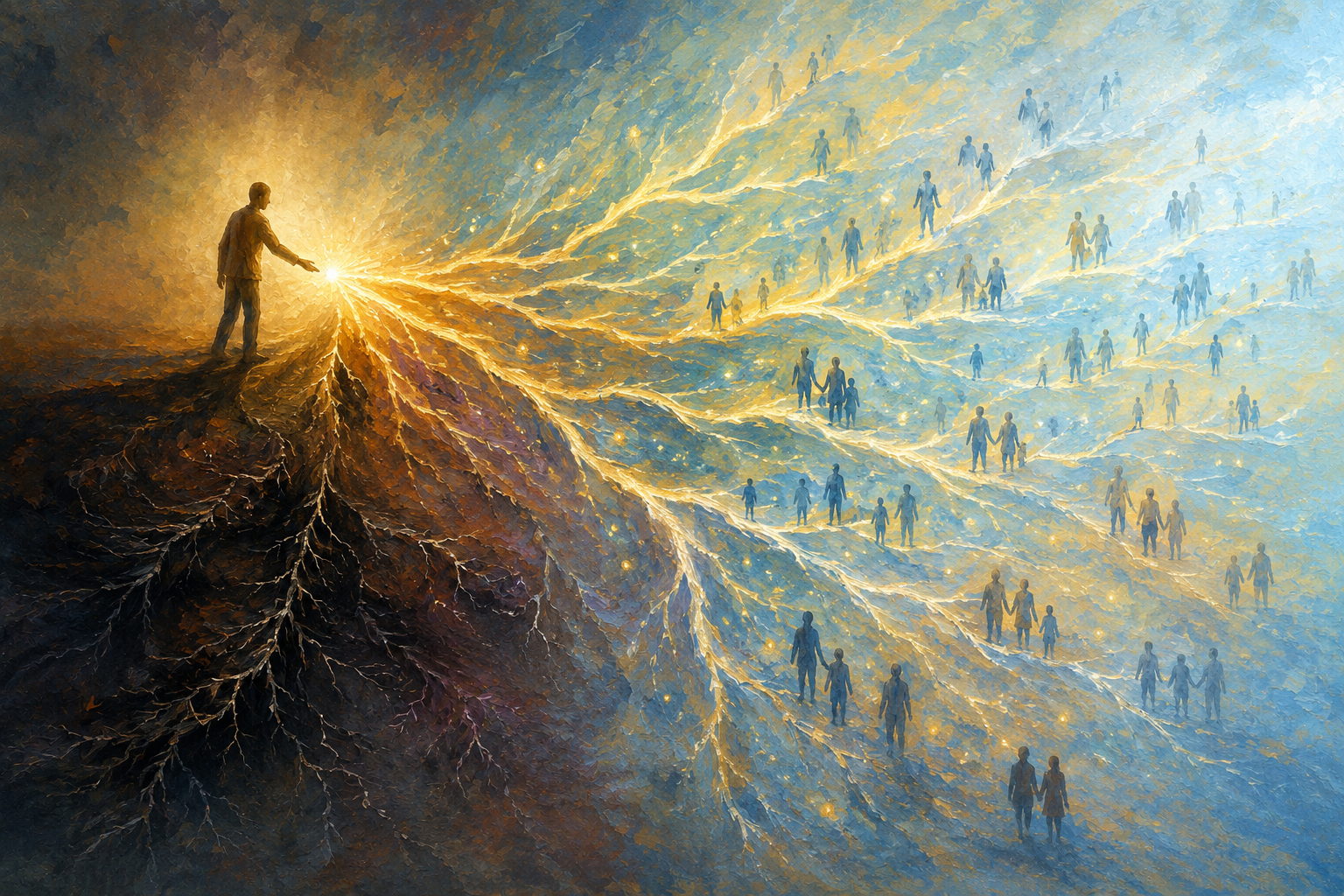
One act becomes two consequences. Those two become twenty. Twenty become two hundred. Not because of magic, but because every choice changes more than the immediate situation. It changes people. It changes relationships. It changes habits. It changes what becomes easier tomorrow than it was today.
The Hebrew Scriptures are filled with this principle.
When Cain became angry with Abel, G-d did not begin by condemning him. Instead, He warned him.
“Sin is crouching at the door. Its desire is toward you, but you must master it.” (Genesis 4:7)
Notice the imagery.
Sin is not presented as a single isolated event.
It is something waiting.
Something that grows if it is fed.
Something that seeks influence.
Cain’s first failure was not simply murder.
It was allowing resentment to mature without confronting it.
And once that happened, the consequences did not stop with Abel.
Violence entered the family.
The family influenced future generations.
By only a few chapters later, Genesis describes the earth itself as filled with violence.
One unattended moral failure became civilizational.
The opposite is equally true.
Think about Abraham.
His decision to leave his homeland could have appeared almost insignificant to anyone watching.
One family moving from one place to another.
Hardly the sort of thing that changes history.
Yet that single act of trust became a covenant.
The covenant became a people.
The people carried Torah.
The Torah shaped civilizations.
Again, what looked small became immeasurable.
This pattern appears throughout Scripture.
Joseph remains faithful while forgotten in prison.
Ruth chooses loyalty over convenience.
Boaz chooses generosity over obligation.
David refuses, more than once, to kill Saul when he has the opportunity.
None of these decisions looked world-changing in the moment.
But each altered the future.
The Hebrew Scriptures consistently teach us that character is not built in extraordinary moments.
Extraordinary moments reveal the character that ordinary moments have already built.
That is why Torah concerns itself so deeply with everyday conduct.
Not because G-d is obsessed with tiny rules.
Because tiny choices become enormous realities.
Modern culture often asks, “What’s the big deal?”
“It’s only one lie.”
“It’s only one shortcut.”
“It’s only one angry outburst.”
“It’s only one act of dishonesty.”
Perhaps.
But it is almost never only one.
Every decision trains the soul.
Every action teaches us what kind of person we are becoming.
When we repeatedly choose honesty, honesty becomes easier.
When we repeatedly choose humility, humility becomes more natural.
When we repeatedly choose resentment, resentment becomes familiar.
The choice changes the chooser.
This is one of the deepest insights of the Hebrew Scriptures.
We do not merely make decisions.
Our decisions make us.
And once they make us, they begin influencing everyone around us.
Parents shape children.
Teachers shape students.
Friends shape one another.
Neighbors shape communities.
Communities shape nations.
Nations shape history.
The ripple is rarely visible from its point of origin.
Imagine dropping a single stone into a still lake.
The stone disappears almost immediately.
If you judged only by the stone, you might conclude that very little happened.
But the water tells a different story.
The ripples continue outward long after the stone is gone.
Human morality works much the same way.
Every word we speak enters someone else’s life.
Every kindness strengthens trust somewhere.
Every cruelty weakens it.
Every example teaches someone what is acceptable.
Every act of courage gives someone else permission to be courageous.
Every compromise quietly lowers the standard for everyone watching.
We are constantly creating ripples we will never live long enough to measure.
This is why I believe spiritual maturity is not primarily about accumulating virtues.
It is about becoming the kind of person whose goodness naturally reproduces itself in others.
Imagine two people.
One helps one hundred people directly.
The other helps ten people become the kind of people who each help one hundred more.
Which life transformed the world more?
We often admire visible impact.
But G-d often works through multiplied impact.
Moses did not enter every home in Israel.
He formed leaders.
The prophets did not merely solve individual problems.
They reshaped moral imagination.
Torah itself is perhaps the greatest example of spiritual exponentialism.
It was given to one generation.
Yet thousands of years later, it still forms consciences, influences laws, inspires justice, comforts the grieving, challenges the powerful, and teaches children who have never seen Mount Sinai.
That is exponential.
It reminds us that the true measure of a life is not found only in what we accomplish personally.
It is also found in what continues because we lived.
So perhaps this week we should stop asking whether today’s choices are important.
That is the wrong question.
A better question is this:
What kind of future am I quietly multiplying today?
Because every choice plants something.
Every habit waters something.
Every word builds something.
And every life leaves behind far more than memories.
It leaves momentum.
May we become people whose ordinary faithfulness creates extraordinary futures.
May our integrity multiply trust.
May our compassion multiply healing.
May our wisdom multiply wisdom.
And may the ripples of our lives continue carrying goodness long after we ourselves have become part of someone else’s history.
Amen.