There are moments in history when confusion is normal. And then there are moments like this one.
This is not just a hard time. Not just an intense period. Not just another turn of the wheel. Something has really gone off the rails, here.
When people began to argue—without irony, without shame—about whether differences between men and women are real… when language began to dissolve faster than it can be spoken… when institutions began to deny what the body, the land, and common sense have always known… when things that were once obvious to everyone now require debate panels, disclaimers, and apology tours… that is not just disagreement. That is a profound disorientation.
This disorientation is a byproduct of chaos, something about which the Hebrew Scriptures are unsentimental. In the Hebrew texts, chaos is not viewed as poetic metaphor but as a real condition of the world. It is not romanticized. It is not mistaken for freedom. Chaos in the Bible is something that, if not restrained, overwhelms both creation and the human mind.
In the beginning, the world is unformed and void—t’hu uvhu describes a world so without structure that it leaves the human being unable to orient—able only to stop and stare until boundaries appear. And the work of Creation that follows, as described, is not magic. It is a separation. Light from dark. Water from water. Heaven from earth. Male and female.
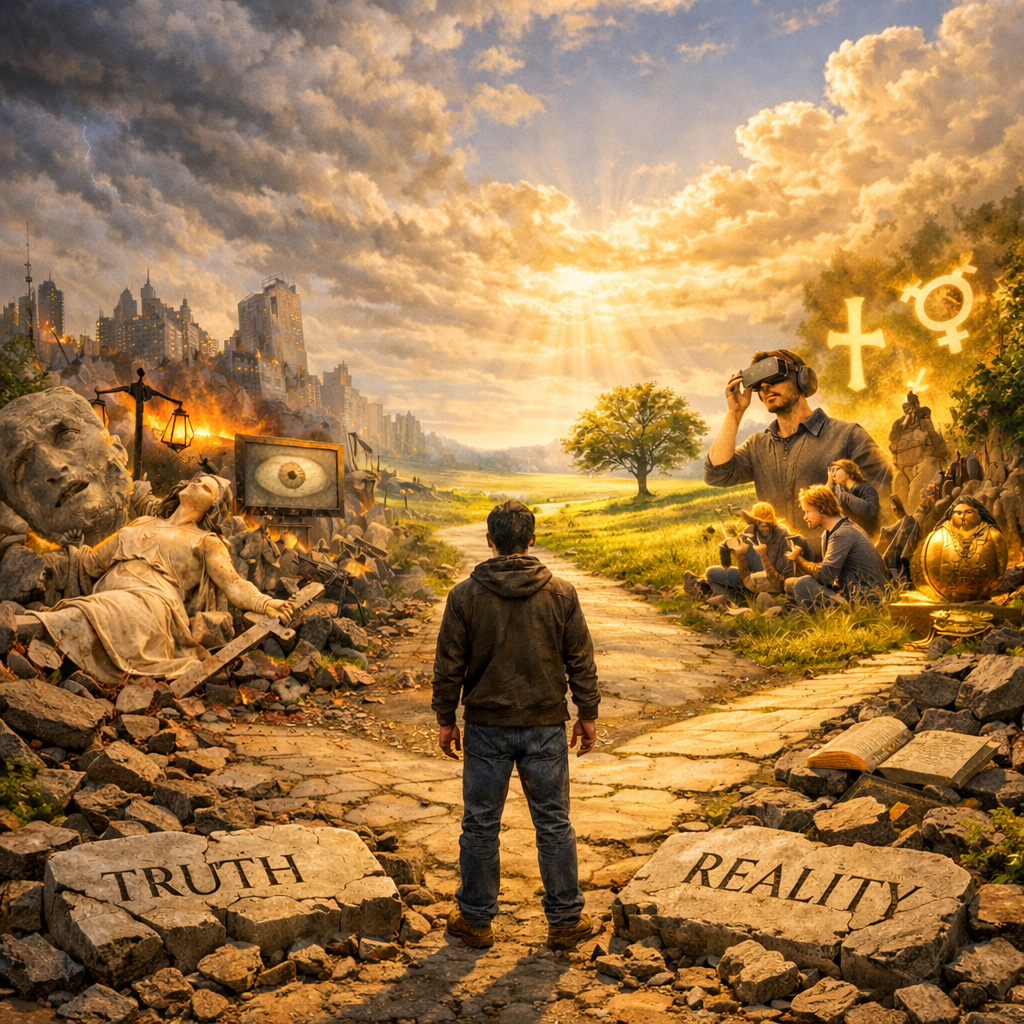
These differences— far from indicating oppression— are a blessing. Because without distinction, nothing can stand, nothing can form, nothing can exist. Reality requires boundaries. Truth requires edges.
⸻
The Hebrew point of view is relentlessly logical.
It teaches that the most dangerous forces are not monsters, but misalignments. And, unfortunately, these are the long-term consequences of that spiritual misalignment.
A lie repeated long enough stops feeling like a lie. A symbol invoked long enough begins to organize reality. And when stories sever themselves from truth, when symbols replace substance, people become trained to worship narratives instead of walking humbly with G-d.
⸻
Are you ready for an uncomfortable truth?
Christianity and, later, Islam effectively severed billions of people from the grounding disciplines of the Hebrew Scriptures, all while claiming continuity with them.
Half the world now lives inside belief systems that claim descent from the Hebrew scriptures— yet systematically detach people from them.
Christianity did not arise as a refinement of Torah. It arose as a replacement theology, whether its adherents know that or not.
And Islam followed the same pattern: assert continuity, then overwrite the foundation.
What was lost in that process was not “rules.” What was lost was alignment.
⸻
The Hebrew scriptures are rooted in reality. They do not float above the world. They do not ask you to suspend reason. They do not promise escape from consequence.
They insist on:
•law
•action
•responsibility
•repair
•restraint
•continuity across generations
No tall tales of virgin births. No human blood sacrifices presented as salvation. No shortcuts into heaven.
⸻
Truth is not fragile. But human perception is. And once perception breaks, people can be convinced of anything.
That is when things start to feel… well, frankly—
batshit crazy.
It’s not that madness suddenly appeared— but the eventual result of anchors being removed.
⸻
Christianity did not simply reinterpret tradition. Christianity introduced something radically different.
It replaced practice with belief. It replaced responsibility with absolution. It replaced law with faith. It replaced alignment with worship of a person.
And once that move was made, the door was opened.
Because when truth is no longer anchored to reality, it can be re-anchored to anything.
⸻
You may think a virgin birth is a harmless myth, but realize that it trains the mind to accept impossibility as virtue.
Blood sacrifice is not a benign poetic symbolism. It teaches that violence redeems.
And salvation through someone else’s suffering is not an example of mercy. It is moral outsourcing.
And here’s where the rubber meets the road: once people are trained to treat contradiction as sacred, once they are taught that believing matters more than resonating with truth, they become vulnerable to every distortion that follows.
Including the ones we are watching right now.
⸻
This is why the world feels unhinged. It’s because generations were taught that truth is something you believe, not something you embody. That consequences can be bypassed. That reality will bend if the story is righteous enough.
But reality does not negotiate. It teaches — patiently, relentlessly — until alignment is restored.
⸻
Here is the mistake many people make when they try to understand what’s happening now.
They look for villains with horns. They look for demons in robes. They look for secret rituals and hidden rooms and imagine that there—somewhere far away—is the cause, the source of corruption.
But the Hebrew scriptures warn about something far more dangerous:
Idolatry.
Not statue worship — but when something made by humans is treated as more real than what G-d actually gave us.
When abstraction outranks embodiment. When ideology outranks nature. When narrative outranks truth.
You do not need supernatural entities for that. You only need humans who forget they are not G-d.
⸻
This is not an attack on people of faith. It is an indictment of a system that asked sincere people to betray their own discernment and called it devotion.
It is not a rejection of G-d. It is a rejection of stories that sever G-d from reality.
⸻
So the task before us is not rebellion. It is realignment.
Not louder belief. Not stricter ideology. But a return to what is grounded, measurable, embodied, and real.
Because without that return, the madness will not slow. It will accelerate.
And the cost will not be abstract. It will be human.
⸻
This is the work now.
To stand in what is real even in the face of pressure to deny it. To speak plainly even when confusion is fashionable. To remember that truth does not need belief to exist. But a world detached from truth can survive only on belief.
We can still choose life and that work— that ancient, unglamorous work— belongs to us now.
It’s time we stepped up to the challenge, while we still can.
Amen