
I’m not trying to annoy anyone. It would be much easier to repeat the same tired clichés—safer, smoother, more comfortable.
But honesty doesn’t live there.
Easy words don’t move anything. They don’t change anything. They just waste time—mine and yours.
So yes, sometimes I’m going to say things that feel uncomfortable. That isn’t always a bad thing.
In more than twenty years as a holistic health practitioner, I’ve come to recognize a particular kind of experience—what I call delicious discomfort.
It can feel intense. So intense that, in another context, you might mistake it for harm. But intensity alone does not mean something is wrong.
Sometimes the pressure, the stretch, the heat is not a warning to stop. Sometimes it is the doorway—to healing, to change, to growth.
The body knows this. The mind forgets.
So let’s start here: not all discomfort is a signal to withdraw. Sometimes it is an invitation to go deeper.
That kind of discomfort isn’t harm. It’s signal. It means something real is happening.
So no—I’m not here to make you comfortable. I’m here to offer something real enough that you can feel it… and maybe, if you’re willing, do something with it.
And that means we may have to touch a few tender places.
Because what I want to talk about today is something you’ve lived with your entire life—and likely never examined.
Something you may participate in without even realizing it.
There’s a phrase that came out of the aftermath of the Second World War, when we tried to examine how an entire society could largely participate in such horrors so commonly. The phrase is: the banality of evil.
In plain terms, it means this:
Evil doesn’t always look like evil. It can look like normal behavior inside a broken system.
It doesn’t have to be dramatic. It doesn’t have to be obvious.
It only requires people to keep doing what they’ve been told… without thinking hard enough to stop.
And I’m going to use two holidays being observed right now to illustrate how easily this happens.
So— two major holidays are being celebrated today: Easter and Passover.
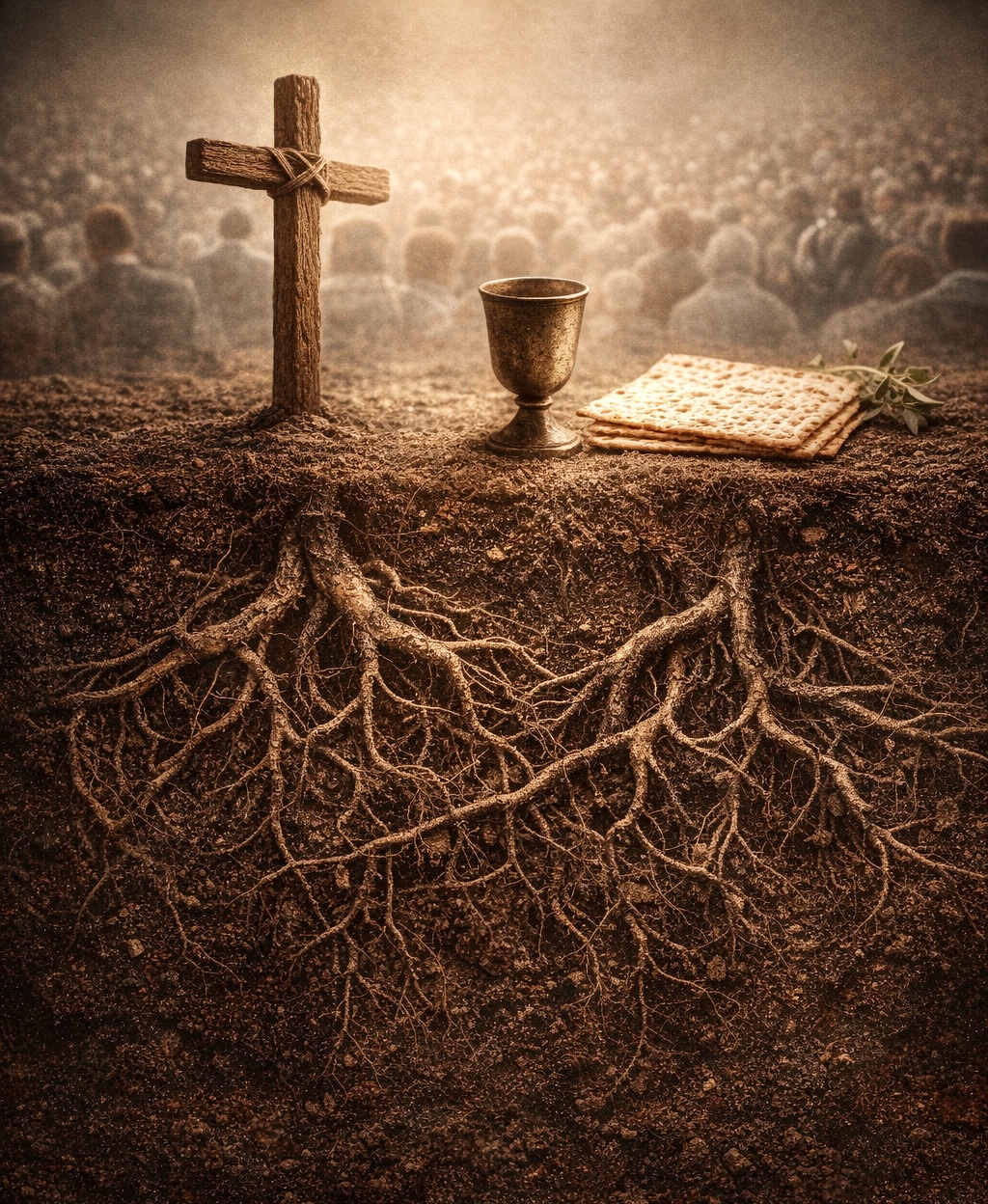
But celebrating is just the surface level. The deeper impact of these holidays is inherited, repeated, and absorbed… Often, without ever having stopped to ask what they actually are.
So slow this down.
Go back—past tradition, past what you were told— to what was.
Obviously, Jesus never celebrated Easter.
There is no version of history—none—where a first-century Jew in Judea is painting eggs, speaking about resurrection as a seasonal metaphor, or aligning himself with a spring fertility festival.
But he did keep Pesach.
Passover/Pesach, the other holiday being observed today—is centered fully on one defining memory: the Exodus of the Israelites from Egypt. And it is observed through a structured meal called a Seder.
“Seder,” in Hebrew, means order, and nothing about it is haphazard.
The evening follows a deliberate sequence shaped by the Haggadah, which translates as “the telling.”
Specific questions are required to be asked. The intention is to draw out the story.
Specific foods are tasted at specific moments —not merely mentioned or enjoyed.
Certain actions are taken at precise moments.
Nothing is random. It is choreographed.
And at the center is one instruction: Each person is to see themselves as if they personally came out of Egypt, to place themselves in the experience.
It is not history alone. It is participation.
Now hold that.
And place it next to Easter.
Eggs. Rabbits. Pastel colors. Fertility symbols. Harvest. Seasonal renewal.
Now, ask this question plainly: What do any of those have to do with a man executed by the Roman Empire and, according to the claim, rising from the dead?
Nothing. No historical connection. No textual connection. No structural connection. What you have is a claimed historical event wrapped in borrowed imagery.
Eggs and rabbits do not come from the story. They come from older seasonal rituals—absorbed and repurposed.
So what emerges is disconnected symbolism.
Now ask— when symbols disconnect from reality, what are they transmitting? Rather than anything solid, they become decorative.
Now— I’m not trying to ruin anyone’s holiday or shame anyone for participating. But there is the obvious question of coherence.
And this matters because, if the symbols are accepted without examination, the next generation inherits a narrative that does not quite track.
And when they recognize that… they may reject not just the symbols—but everything beneath them.
So pause here.
Because the deeper point isn’t the holiday itself. It’s the inheritance of ideas.
Once people are trained to inherit symbols without examining them… they can also inherit narratives about people without examining those either.
And this is where that delicious discomfort is going to start to surface.
When you read the Hebrew Scriptures, you see a people in covenant with G-d—failing, rising, arguing, repenting, rebuilding.
A people called to responsibility, not perfection.
Nothing in the texts suggests they are disposable. Nothing suggests they are replaced. In fact, quite the opposite is true.
But when you open the New Testament, that same people are recast. As a problem. An obstacle. A warning.
That shift didn’t happen by accident.
Early writers were trying to explain a reality: the Jewish people did not accept the claims being made about Jesus. And instead of letting that stand—letting Jews remain faithful to the Torah they were commanded to keep—that rejection was reframed. Not as disagreement. Not as fidelity. But as blindness. Hardness. Even guilt.
And once a people are framed as guilty in the text… history begins to echo it in the world. You see it in language that turns “the Jews” into a hostile monolith. You see it in interpretations that justified collective blame. You see it in the reframing of Torah—from covenant to burden.
And once the covenant becomes a burden… the people carrying it become obstacles.
These ideas don’t stay in books. They become sermons. Art. Law. Eventually—violence.
For centuries, Jews were accused of deicide—the killing of G-d. That accusation didn’t appear out of nowhere. It grew from these new interpretations of their ancient texts. And it fed expulsions, forced conversions, inquisitions, pogroms… and worse.
Most people today don’t intend that. They’re not reading with hatred.
But intention doesn’t erase structure. If the blueprint is distorted, even well-meaning builders reproduce it.
And this is not abstract.
Antisemitic incidents have surged in recent years.
Globally, surveys show roughly one in four people hold deeply entrenched antisemitic attitudes. And though Jews make up a small percentage of the population (about 2-3% in the US), they are disproportionately targeted and account for over half of religiously motivated hate crimes.
Sit with that.
Because this is where it stops being theoretical.
These are patterns. And patterns come from somewhere.
So the question sharpens:
How does such a small population become the consistent target of that level of hostility—across countries, cultures, and centuries?
It’s not random. It’s not new. And it didn’t appear overnight.
Something has been carried forward. Repeated. Normalized. Absorbed so deeply that most people don’t even recognize it as something they were taught.
And that’s the connection. Not simple. Not accusatory. But honest.
Because once you see it… you’re no longer neutral. You don’t get to say, “I didn’t know.” You don’t get to say, “That’s just how it is.”
At some point, inheritance becomes participation. And participation—whether conscious or not—has consequences.
So the question isn’t just what is true?
The question is: What are you going to do with it?
Because this isn’t about taking something away from you. It’s about asking whether what you’ve been given actually holds. Whether it’s coherent. Whether it’s rooted. Whether it aligns with the G-d you claim to believe in.
And if it doesn’t— then the work is not to defend it. The work is to be honest enough to let it go.
Not everything we inherit is meant to be carried forward. Some things are meant to be examined. Refined. Or left behind entirely.
That’s not loss. That’s integrity. That’s growth. That’s healing.
Truth does not need decoration. It does not need borrowed symbols or softened contradictions to survive. It holds on its own.
And if it doesn’t hold— then it is not truth. It is tradition. And those are not the same thing.
Amen.